Most of the wind mitigation inspections I do in Fernandina Beach, Yulee and Callahan start the same way: an insurance renewal arrives, the premium has gone up again, and somebody tells the homeowner to "get a wind mit." Here is what that actually means, and what I am doing while I am up in your attic.
Why insurers care
Florida law requires insurance companies to offer premium credits for construction features that reduce wind damage. The insurer does not send anyone to look at your roof, though. They rely on a standard form, the Uniform Mitigation Verification Inspection form (OIR-B1-1802), filled out and signed by a qualified inspector. No form, no credit, even if your house has every feature on the list.
What I check, and where
The roof covering. I note the type of roof and, where it can be documented, when it was installed and whether it meets the building code in force at that time. Newer roofs usually score better.
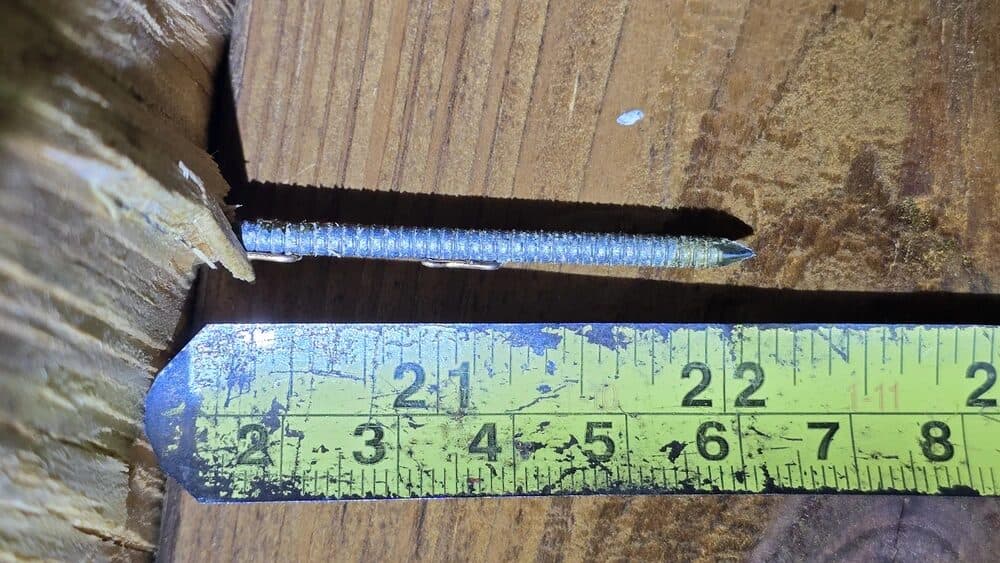
How the roof deck is attached. From the attic I measure the size of the nails or screws holding the plywood or OSB to the rafters and trusses, and how far apart they are. Longer fasteners at closer spacing hold the deck on better in high wind. The photo at the top is exactly this step: a tape measure next to a deck fastener.
How the roof is tied to the walls. This is the one that often makes the biggest difference. I look at where the trusses meet the top of the wall: are they just nailed at an angle (toe-nails), held with metal clips, or wrapped with single or double straps? Each step up is worth more on the form.
Roof shape. Hip roofs, which slope down on all four sides, handle wind better than gable roofs, and the form records the proportions.
Secondary water resistance. If the roof has a sealed underlayment or taped seams under the covering, it can earn a credit. This is often only visible during a re-roof, so keep your roofer's paperwork.
Opening protection. Impact-rated windows and doors, approved shutters, and the garage door all count. Every opening needs to be protected for the full credit, so one unprotected door or window can make a difference.
How to get ready
- Make sure I can get into the attic. Clear the closet or the garage shelf under the hatch.
- Find any permits, roof invoices or window and shutter product approvals you have. Documentation can turn a "can't verify" into a credit.
- If you have shutters, have them where I can see them, even if they are stored in the garage.
The visit itself usually takes 20 to 30 minutes. I sign the form and email it to you before I leave your driveway, and you forward it to your insurance agent. A wind mitigation report is valid for up to five years.
Do it together with a 4-point
If your home is older, your insurer may also want a 4-point inspection covering the roof, electrical, plumbing and heating and cooling. Doing both in one visit saves you a second appointment.
Have a question about your house? Book a wind mitigation inspection online, read more about wind mitigation, or call or text me at 904-321-9121.